
SEO Is Dead in 2026: The 3 Frameworks That Replaced It (AEO, GEO, AIO Explained)
Traditional SEO stopped working. ChatGPT eats Google traffic. AI Overviews kill clicks. Discover the three new frameworks dominating search in 2026 AEO, GEO, and AIO and the exact playbook to win.
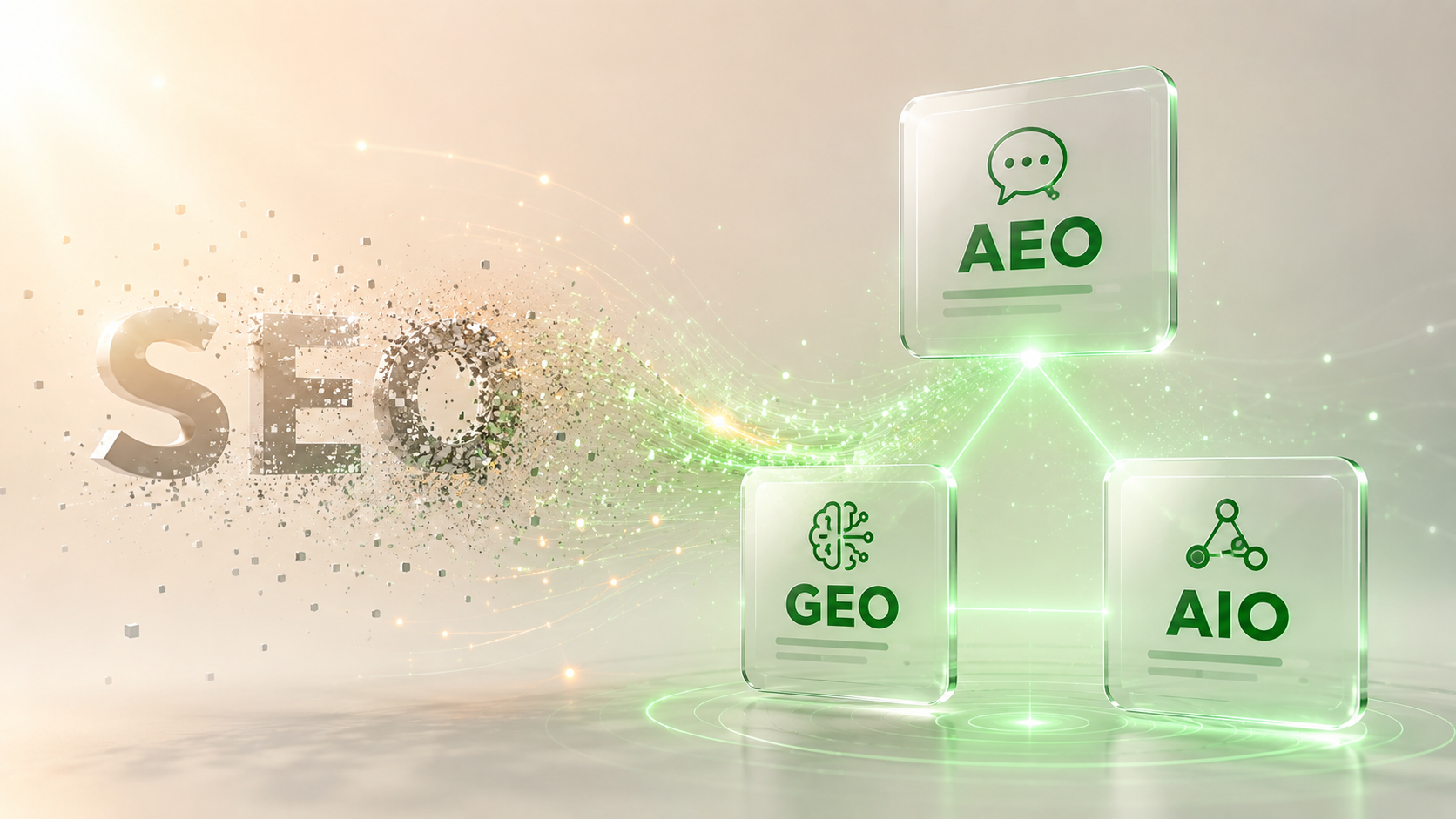
The phrase "SEO is dead" gets thrown around every few years. This time, it's actually true.
Not because Google disappeared. Google still serves billions of searches daily. But Google has stopped being the only or even the primary way people discover information, products, and businesses.
In 2026, three new frameworks have effectively replaced traditional SEO:
AEO (Answer Engine Optimization)
GEO (Generative Engine Optimization)
AIO (AI-Indexed Optimization)
If you've never heard of these, you're not alone. Most marketers haven't caught up yet. But that gap is exactly why early adopters are dominating search visibility right now while their competitors slowly become invisible.
This guide breaks down each framework, why it matters, and the exact tactics to implement starting today.
Why Traditional SEO Stopped Working
Old SEO had a simple promise: optimize for Google, rank on page one, get traffic.
That promise broke in 2025 and shattered in 2026. Here's why:
Google's AI Overviews Eat 60% of Clicks
Google's AI Overviews now appear at the top of 60% of search results. They generate comprehensive answers that satisfy the user without ever needing a click. The 10 blue links below sit unseen. Your "page one ranking" delivers a fraction of the traffic it did two years ago.
ChatGPT Replaces Search for Billions of Queries
Over 800 million people use ChatGPT weekly. They don't search Google for product recommendations, how-to guides, or business research. They ask AI directly. If your brand isn't mentioned in those AI conversations, you don't exist for those customers.
Voice and Conversational Search Dominate
50% of all searches in 2026 are voice or conversational. Users speak in full questions, not keywords. Old keyword-stuffing tactics fail completely because the search behavior is fundamentally different.
Gen Z and Millennials Default to Alternative Platforms
40% of Gen Z uses TikTok, YouTube, or AI assistants before Google for any search. Your beautifully optimized blog post never gets seen by an entire generation of customers.
Schema Markup Is Now Required, Not Optional
Without structured data, AI systems literally cannot parse your content. You become invisible to AI Overviews, ChatGPT citations, Perplexity sources, and Gemini answers. Schema went from "nice to have" to "required for existence."
The old SEO playbook keyword research, backlink building, blog posts targeting search volume, still works at a fraction of its former effectiveness. But it's not enough anymore. Not even close.
What Is AEO? (Answer Engine Optimization)
AEO is optimizing your content to be the direct answer that voice assistants, AI summaries, and search engines pull from.
When someone asks "What's the best AI tool for landing pages?" AEO is the framework that gets your tool named in the answer instead of buried in 10 links.
The 5 Core AEO Tactics
1. Structure Content Around Specific Questions
Stop writing articles titled "Marketing Tips." Start writing "How Do I Get My First 100 Customers as a New Business?" Question-format titles match how people actually search in 2026.
2. Write 40-60 Word Answer Paragraphs at the Top
Below every article H1, include a concise paragraph that answers the question directly. AI systems pull these paragraphs as featured snippets and direct answers.
3. Implement FAQ Schema Markup on Every Page
FAQ schema is the highest-ROI structured data you can add. It signals to Google and AI systems that your page contains direct, parseable answers to specific questions.
4. Use HowTo Schema for Tutorial Content
Any "how to" content should use HowTo schema. This dramatically increases your chances of being featured in voice search results and AI step-by-step answers.
5. Match Natural Language Patterns
Write the way people speak. Avoid corporate jargon. Use contractions. Ask and answer questions in conversational language. AI systems prefer content that sounds human because that's what their users sound like.
What AEO Looks Like in Practice
Bad headline: "Email Marketing Strategy Guide"
Good AEO headline: "How Do I Build an Email Marketing Strategy That Actually Converts?"
Bad opening: "Email marketing is a powerful channel..."
Good AEO opening: "To build a high-converting email marketing strategy, focus on three things: segmenting your list by behavior, sending value-first content, and optimizing for mobile open rates. Most businesses fail because they prioritize sending volume over relevance."
That second example gets pulled into Google's AI Overviews. The first one doesn't.
What Is GEO? (Generative Engine Optimization)
GEO is the most important framework in 2026. It's optimizing your brand and content to be cited, recommended, and mentioned by generative AI systems like ChatGPT, Gemini, Claude, and Perplexity.
Unlike SEO, GEO isn't about ranking pages. It's about brand recognition by AI.
Why GEO Matters More Than Anything Else
When someone asks ChatGPT "Who's the best web design agency for small businesses?" ChatGPT names 3-5 specific companies with reasoning. If your business isn't in that answer, you've lost that customer before they even knew they had a choice.
This is happening millions of times per day across every industry. The brands getting cited are winning. The ones not cited are invisible.
The 6 Core GEO Tactics
1. Build Comprehensive Authority Signals
AI systems prioritize brands with verifiable expertise. Your About page needs founder names, credentials, founding year, specific expertise, and clear positioning. Anonymous brands get ignored.
2. Get Listed in AI Training Datasets
AI models are trained on specific datasets Wikipedia, Reddit, Stack Overflow, GitHub, major news sites, industry directories. Getting mentioned on these sources dramatically increases AI citation likelihood.
3. Create Comprehensive, Cite-Worthy Content
Short articles get ignored by AI. Long, well-sourced, expert-level content (1,500-3,000 words minimum) gets cited because AI systems prefer authoritative sources over thin content.
4. Use Extensive Structured Data
Beyond basic schema, implement Organization, Person, Article, FAQ, HowTo, Product, and Review schemas everywhere relevant. AI systems use this structured data to understand and categorize your brand.
5. Encourage Third-Party Mentions
When other authoritative websites mention your brand, AI systems treat you as more credible. Guest posts, podcast appearances, press mentions, and directory listings all compound.
6. Maintain Knowledge Graph Presence
If you don't appear in Google's Knowledge Graph, you're invisible to most AI systems. Build out your Wikidata entry, ensure Google Business Profile is comprehensive, and get listed on major industry directories.
How to Measure GEO Performance
Test your brand directly:
Open ChatGPT, Gemini, Claude, and Perplexity
Ask: "What are the best [your category] for [your customer type]?"
Count how often your brand appears
Track this monthly
If you're never mentioned, you have a GEO problem. The brands citing strategies above fix this within 60-90 days.
What Is AIO? (AI-Indexed Optimization)
AIO is the technical foundation that makes both AEO and GEO work. It's ensuring your content is instantly discoverable and indexable by both Google and AI crawlers.
Without AIO, your perfectly optimized content sits invisible to the systems that need to find it.
The 5 Core AIO Tactics
1. Submit URLs to Google's Indexing API Immediately
Don't wait for Google to crawl your new content. Push it directly through the Indexing API the moment you publish. Pages get crawled within hours instead of weeks.
This is so impactful that we built a one-click indexing tool directly into the Fancy Digitals dashboard. Every blog post and portfolio project published auto-notifies Google immediately.
2. Maintain a Comprehensive, Updated Sitemap
Your sitemap should include every important page, with accurate lastModified dates and appropriate change frequencies. Most sitemaps we audit are missing 30-50% of important content or have stale dates that signal inactivity to crawlers.
3. Optimize for Fast Crawl Speeds
Google and AI crawlers have crawl budgets. If your site loads slowly, fewer pages get crawled. Core Web Vitals matter for indexing, not just user experience.
4. Implement Proper Canonical Tags
Duplicate content confuses AI systems. Canonical tags tell crawlers which version of a page is the authoritative one. Without them, your authority gets split across multiple URLs.
5. Use llms.txt to Guide AI Crawlers
The new llms.txt standard lets you specifically guide AI crawlers to your most important content. It's like robots.txt but for AI systems. Implementing this signals to ChatGPT, Perplexity, and others which pages they should prioritize for citations.
How to Measure Your Performance Across AEO, GEO, and AIO
You can't improve what you don't measure. Here's the 2026 tracking stack:
For AEO Performance:
Featured snippet appearances in Google Search Console
"People Also Ask" appearances for your target queries
Voice search ranking through tools like Search Console + manual testing
Click-through rates on question-format pages
For GEO Performance:
Monthly brand mention testing across ChatGPT, Gemini, Perplexity, Claude
Citation tracking through Perplexity (it shows sources)
Brand search volume in Google Trends
Direct traffic increases from AI tools
For AIO Performance:
Google Indexing API quota usage and success rates
Sitemap coverage in Search Console
Crawl rate and crawl errors
Time-to-index for new content
The All-in-One Solution: AI Visibility Score
Manually tracking all of this is exhausting. We built the Fancy Digitals AI Recommendation Engine specifically to consolidate this measurement.
In 30 seconds, it scans your site and shows you:
Overall AI Recommendation Score out of 100
Detailed breakdown across all 10 signals AI systems use
Top 3 improvements you can make today
How ChatGPT, Gemini, and Perplexity currently evaluate your brand
Competitor comparison (Pro plan)
No signup required. No credit card. Most businesses score below 35. The top performers score above 75.
Run a free scan now to know where you stand.
The 5-Step Action Plan to Dominate Search in 2026
If you only do five things this year, do these:
Step 1: Audit Your Current AI Visibility
Run a free AI Recommendation Engine scan. Document your baseline score across all 10 signals. This becomes your starting point for measuring improvement.
Step 2: Add Comprehensive Schema Markup
Implement Organization, Article, FAQ, HowTo, BreadcrumbList, and Person schema on every important page. Validate with Google's Rich Results Test. This single action lifts visibility across AEO, GEO, and AIO simultaneously.
Step 3: Restructure Top Content Around Questions
Take your 10 most important pages. Rewrite headlines as questions. Add 40-60 word answer paragraphs at the top. Add FAQ sections at the bottom with FAQ schema. This converts existing content into AEO-optimized assets.
Step 4: Submit Every Publish to Google's Indexing API
Stop waiting weeks for content to get indexed. Push new content directly through the Indexing API. Fancy Digitals has this built into the dashboard auto-triggers on every blog post and portfolio project publish.
Step 5: Build Authority Signals Aggressively
Strengthen your About page with credentials. Add author bios with verifiable expertise. Get listed on industry directories. Pitch yourself as a podcast guest. Each of these compounds your GEO performance over time.
Do all five and you'll be in the top 5% of businesses prepared for AI-driven search.
Common Mistakes Businesses Make in 2026
Even businesses that know about AEO, GEO, and AIO often implement them wrong. Avoid these traps:
Mistake 1: Treating AI Systems Like Google
ChatGPT doesn't rank pages. It recommends brands. Your strategy needs to shift from "ranking content" to "being mentioned in answers."
Mistake 2: Publishing Thin Content
AI systems prefer comprehensive sources. A 500-word post optimized for keywords gets ignored. A 2,500-word guide with clear structure and authority signals gets cited.
Mistake 3: Anonymous or Generic Brands
If your About page doesn't have your name, your face, and your credentials. AI systems can't verify you. Generic "we're passionate about excellence" copy is worthless.
Mistake 4: Ignoring Mobile and Speed
Slow sites get crawled less. AI systems deprioritize sites with poor Core Web Vitals. Your beautiful content gets buried because your site loads slowly.
Mistake 5: Inconsistent Information Across Platforms
If your business name, address, phone, or description differs across your website, LinkedIn, Google Business Profile, and directories. AI systems flag this as untrustworthy. Consistency is binary.
The Window Is Closing Faster Than You Think
Right now, fewer than 5% of businesses are actively optimizing for AEO, GEO, and AIO. The 5% acting on this in 2026 will dominate AI-driven discovery for the next decade.
By 2028, this won't be optional. Businesses that haven't adapted will lose 40-60% of their organic discovery traffic. Not because they did anything wrong, because their customers stopped finding them.
The cost of acting now: a few weeks of focused optimization work.
The cost of waiting: rebuilding your entire digital presence in 2028 while competitors who started early have a 24-month head start.
Start Where the ROI Is Highest
If you can only do one thing today, do this: scan your current AI visibility.
The Fancy Digitals AI Recommendation Engine gives you a free, comprehensive analysis in 30 seconds. You'll know exactly where you stand across all 10 signals AI systems use to evaluate brands. You'll get specific, prioritized improvement actions.
No signup. No credit card. Just real data about whether ChatGPT, Gemini, and Perplexity currently recognize your brand.
The businesses winning in 2026 aren't the ones with the biggest budgets. They're the ones who measured first and acted fastest.
The future of search has arrived. The only question left is whether you're ready for it.
Bashir Ismail
Founder
Founder of Fancy Digitals. Building AI-powered tools and digital experiences for small businesses worldwide.
Related Articles
Recommended for You
Build a Landing Page in 60 Seconds
AI generates 9 sections, 6 tones, 5 languages — no code needed.
Free AI Resume Builder
Land your dream job. Build an ATS-friendly resume in minutes.
Is Your Site AI-Ready?
Get a free AI Visibility Score. See how ChatGPT sees your business.
Get Growth Insights
Weekly AI marketing tips for founders. No spam.